


Oil Shock from US–Iran Tensions Drives Businesses to Seek New Frontiers — Timor-Leste Emerges as a Strategic Alternative
- Han Hui Tan
- Apr 7
- 4 min read


Image source: PBS
From supply shocks to strategic shifts, a small Southeast Asian nation is entering the conversation
When oil prices began climbing again in the wake of renewed tensions between Washington and Tehran, the immediate concern was predictable: inflation, transport costs, and another round of pressure on already fragile supply chains.
But beneath the surface, a quieter shift is taking place.
Across manufacturing floors, trading desks, and boardrooms, businesses are beginning to ask a different question — not how to absorb the shock, but where to move next.
The concern is not just the price of oil, but the uncertainty surrounding it. The Strait of Hormuz, long considered one of the world’s most critical energy chokepoints, has once again become a focal point of risk. Even the possibility of disruption has been enough to rattle markets and push companies into contingency planning.
For many, the conclusion is becoming difficult to ignore: the cost structures that once made sense may no longer hold.
A gradual shift away from traditional hubs
In recent months, logistics operators and mid-sized manufacturers have begun reassessing their geographic exposure. Energy-intensive environments — particularly those heavily dependent on imported fuel — are becoming less predictable.
“It's not just about cost anymore,” said one regional distributor based in Southeast Asia. “It’s about stability. If your entire operation depends on fuel routes that can be disrupted overnight, that’s a structural risk.”
This recalibration is not happening overnight, nor is it being announced loudly. Instead, it is unfolding incrementally — pilot projects, exploratory partnerships, small-scale relocations.
The pattern, however, is consistent: diversification away from saturated, high-cost markets.
An unlikely name starts to surface

Image Source:TheCruiseWeb
In conversations about alternative destinations, one country is appearing with increasing frequency: Timor-Leste.
Long overshadowed by its larger neighbors, the young nation has rarely featured prominently in global investment discussions. Its economy remains small, its infrastructure uneven, and its industrial base limited.
Yet those same characteristics are beginning to draw attention.
“There’s very little legacy cost built into the system,” said an investor who recently visited the capital, Dili. “You’re not competing with decades of entrenched players. In some sectors, you’re building from zero.”
That absence of competition — once seen as a weakness — is now being reframed as an opportunity.
Demand without supply
Data source: World Bank, ADB
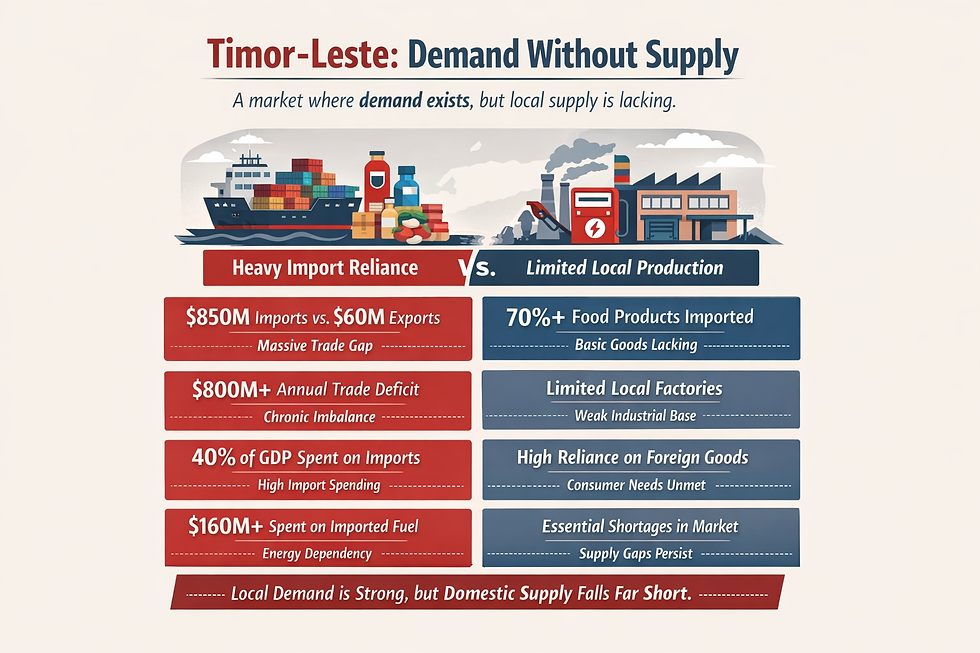
What is emerging in Timor-Leste is not just a theoretical market gap, but one that becomes immediately visible on the ground.
In Dili, shop shelves are often stocked with imported goods—from packaged food to basic household items—most of which arrive through fragmented supply chains. Conversations with local distributors and retailers point to a consistent pattern: demand is present, but supply is irregular, and in many cases, insufficient.
“We can sell more if we can get consistent stock,” said one retailer operating in the capital. “Sometimes customers come in asking for products we simply don’t have.”
Across sectors, similar observations surface. Construction projects frequently depend on imported materials with fluctuating availability. Small businesses report delays in sourcing inventory. Even essential consumer goods can experience periodic shortages, particularly outside urban centers.
For businesses used to highly competitive markets, the contrast is notable. Here, the challenge is not capturing demand from competitors—but meeting demand that is already there.
Industry participants describe it less as an emerging market, and more as an under-supplied one—where commercial activity is constrained not by lack of buyers, but by the absence of consistent, localised supply systems.
Energy shock as a catalyst, not a cause
The current oil crisis did not create this interest — but it has accelerated it.
Rising fuel costs are forcing companies to rethink long-distance supply chains. In parallel, smaller markets are gaining appeal precisely because they allow for more localized, contained operations.
In places like Timor-Leste, businesses can often operate at a scale where exposure to global volatility is reduced. Supply chains are shorter, operational footprints are smaller, and adaptability is higher.
It is not a perfect hedge — but in an uncertain environment, it is an attractive one.
A shift that may outlast the crisis
Whether oil prices stabilize or continue their upward trajectory, the decisions being made today may have longer-term consequences.
Once companies establish footholds in new markets, they rarely retreat entirely. Instead, they diversify permanently.
In that sense, the current crisis may serve as a turning point — not just for energy markets, but for how businesses think about geography.
And in that evolving map, places once considered peripheral, like Timor-Leste, are beginning to find their place.
Exploring Opportunities in Timor-Leste
As global energy uncertainty continues to reshape business decisions, markets like Timor-Leste are gradually moving from the periphery into strategic consideration.
For companies seeking a clearer understanding of operating conditions, regulatory landscape, and practical market entry pathways, access to on-the-ground insight remains critical.
Further information, market perspectives, and field-based observations can be found at:
Website: www.invest-timor.com
Whatsapp:
+60 12-736 1172 (Malaysia Line) +670 7402 9163 (Timor-Leste Line) +853 6556 4077 (Greater-China Area Line)



Comments